

Key Takeaways
- Understanding SAP Services helps businesses streamline operations and improve data connectivity across departments.
- The SAP ERP System lays the foundation for effective management of complex business processes.
- Effective SAP implementation requires aligning technology with specific business workflows for optimal results.
- SAP consulting transforms business needs into actionable system configurations that enhance efficiency.
- Integrating systems like CRM SAP Module with a Fleet Management System allows for seamless data flow and reduces manual entry.
Synobiz Systems Pvt. Ltd. is a leading provider of SAP ERP consulting and implementation services. For businesses looking to improve operational control, connect departments, and work with reliable business data, choosing the right SAP Services can make a major difference. From planning and deployment to integration and ongoing support, SAP can become a practical foundation for managing complex business processes.
What Are SAP Services?
SAP Services cover the professional work required to plan, configure, deploy, connect, maintain, and improve SAP-based business systems. These services are not limited to software installation. They also involve understanding business workflows and aligning technology with operational requirements.
A business may use different SAP Software Applications across finance, sales, inventory, purchasing, customer management, and other functions. The objective is to create a connected environment where information can move across processes without unnecessary duplication.
An effective SAP ERP System can also give management better visibility into business operations. The right service approach depends on the company’s processes, existing technology, data structure, and long-term requirements.
SAP Implementation: Building the Right Foundation
SAP implementation is the process of introducing an SAP solution into an organization and configuring it around business needs. A strong implementation starts with process analysis rather than simply selecting features.
During implementation, businesses may define workflows, user roles, master data, reporting requirements, and system configurations. SAP Software Applications can then be structured to support the way teams actually work.
Common implementation activities include:
- Reviewing existing business processes and identifying system requirements.
- Configuring the selected SAP solution around those requirements.
- Preparing and validating business data before migration or use.
- Testing workflows, reports, and user access.
- Training teams and preparing the organization for go-live.
The scope may vary depending on whether the business needs a focused solution or a broader SAP ERP System across multiple functions. Industry-specific requirements can also influence the configuration, including the need to connect SAP with tools such as a Fleet Management System.
SAP Consulting: Turning Business Needs into System Decisions
SAP consulting helps businesses make informed decisions before and during an ERP project. Instead of treating software as a standalone product, consulting connects system capabilities with business priorities.
A good consultation may examine existing workflows, process gaps, reporting needs, integration requirements, and opportunities for improvement. For example, a business evaluating a CRM SAP Module may need to consider how customer information should connect with sales, service, and other internal processes.
The same approach applies when reviewing SAP Applications for different departments. The goal is to create a practical system structure instead of adding technology without a clear operational purpose.
Businesses may also use consulting when planning upgrades, migrations, ERP selection, or broader digital transformation. Working with an experienced SAP IT Company can help decision-makers evaluate technical choices while keeping business processes in focus.
SAP Integration: Connecting Systems and Data
Businesses nowadays seldom ever use a single application.SAP may need to exchange information with CRM platforms, payment systems, third-party tools, legacy applications, or specialized operational software.
SAP integration connects these systems so that information can flow between them more effectively. This can include ERP-CRM connectivity, APIs, middleware, and other integration methods depending on the technical environment.
For example, a CRM SAP Module may need to share customer or sales information with other business functions. A Fleet Management System may also need to exchange operational information with ERP processes where vehicles, service activities, purchasing, or related workflows are involved.
Integration can also reduce the need for repeated manual data entry. With properly connected SAP Applications, teams can work with information across systems while maintaining more consistent workflows.
SAP Support: Keeping Business Operations on Track
A project for SAP goes beyond just going live. Support plays a vital role in helping companies manage issues related to the use of the system, changes, upgrades, adjustment of processes, and any other needs that arise with evolving operations.
The type of support could be related to troubleshooting, configuring, assisting the users, reviewing the system, or other needs that come up after implementation. Support may also be necessary when the business units decide to implement new SAP Software Applications or make changes to their existing processes.
Where the companies use an SAP ERP System, it could be more relevant to seek support when there are multiple departments whose processes are interconnected and whose problems might have impacts on finance, procurement, sales, inventories, or reporting, among other areas.
How the Four SAP Service Areas Work Together
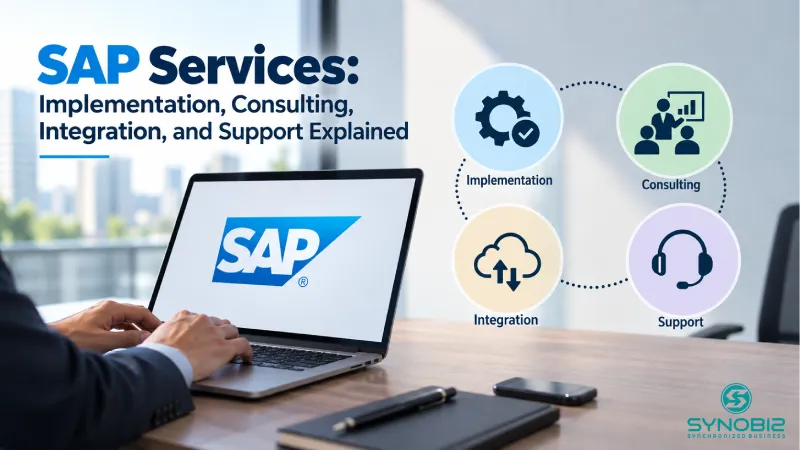
Implementation, consulting, integration, and support are closely connected. Businesses often need more than one of these services during an ERP lifecycle.
| Service | Primary Focus | Typical Business Need |
|---|---|---|
| Implementation | System deployment | Starting or replacing an ERP platform |
| Consulting | Business and technology alignment | Planning and process improvement |
| Integration | System connectivity | Connecting SAP with other applications |
| Support | Ongoing assistance | Stability, updates, and optimization |
| Migration/Upgrade | Technology transition | Moving to newer editions or environments |
For instance, a business may begin with consulting, move into implementation, connect a CRM SAP Module and a Fleet Management System, and then continue with support after go-live. This connected approach can make ERP management more practical over the long term.
Why Choose Us
Synobiz Systems Pvt. Ltd. provides ERP consulting and digital transformation services with expertise across SAP Business One, SAP S/4HANA, and other business technologies. Our services include implementation, integration, strategic consulting, migration, training, data management, and ongoing support. We focus on aligning technology with business processes so organizations can build practical and scalable ERP environments around their operational needs.
Conclusion
The selection of SAP Services is not only about the selection of software but the implementation of it lays down the foundation, consultancy ensures that technology aligns with business goals, integration integrates various systems while support aids in dealing with changes. The proper use of SAP Services ensures connected processes among various departments with the help of SAP Applications while SAP ERP System acts as a platform for businesses. Businesses that make use of Fleet Management System or customer-oriented tools or other enterprise applications could integrate their processes using a proper strategy.
Ready to discuss your SAP requirements with Synobiz Systems Pvt. Ltd.? Speak with our team about implementation, consulting, integration, or support for your business. Contact us at +91 97247 99092 or email info@synobiz.com to discuss the right SAP solution for your organization.
Frequently Asked Questions
SAP Services typically include implementation, consulting, integration, and support. These services help businesses effectively plan, deploy, connect, and maintain their SAP-based systems to align with their operational needs.
SAP consulting assists businesses in making informed decisions related to their ERP projects. It focuses on aligning system capabilities with business priorities and identifying process improvements, ensuring that technology supports operational goals.
SAP implementation involves introducing an SAP solution into an organization and customizing it to meet business requirements. Key activities include reviewing existing processes, configuring the system, validating data, and training staff for a successful go-live.
SAP integration connects various systems, such as CRM platforms and operational software, to ensure effective information flow. This can be achieved through APIs, middleware, or other integration methods, which streamline workflows and reduce manual data entry.
Ongoing support is crucial for maintaining the stability and efficiency of SAP ERP systems. It addresses issues related to system use, upgrades, and reconfiguration, ensuring that businesses can adapt their processes as they evolve.