Key Takeaways
- SAP ERP connects core business processes, improving efficiency by integrating information from finance, procurement, sales, and more.
- Choose the right SAP ERP solution based on specific business requirements, considering operational needs rather than just size.
- A connected SAP ERP platform enhances visibility, providing timely insights into financial performance and operational activities.
- Implementing an SAP ERP system can significantly reduce manual data entry, streamline reporting, and improve inventory management.
- Selecting a reliable SAP partner is critical for successful implementation, ensuring proper configuration, training, and support throughout the process.
Synobiz Systems is a Leading SAP ERP Solutions Provider.
Opportunities come with growth, but so does complexity.More customers, suppliers, products, employees, transactions, locations, and departments mean more information to manage. When important data sits in separate systems, teams can spend valuable time searching, reconciling, and preparing reports instead of acting on them.
This is where SAP ERP becomes relevant. ERP connects core business processes through integrated applications and shared information, giving organizations a more unified view of finance, procurement, supply chain, sales, manufacturing, and other operations. SAP describes ERP as a system that helps organizations streamline core processes and maintain a single source of truth.
For businesses planning digital transformation, the objective is not simply to purchase SAP Software. The real objective is to build a connected business environment that supports better control, efficiency, and informed decisions.
What Is SAP ERP?
SAP ERP refers to enterprise resource planning solutions from SAP that integrate important business functions within a connected technology environment.
Depending on business size and requirements, SAP offers different ERP solutions. SAP Business One, for example, is designed for small and midsize businesses and covers areas such as accounting and financials, purchasing, inventory, sales, customer relationships, reporting, and analytics.
Larger organizations may evaluate SAP Cloud ERP or SAP S/4HANA based on their operational scale and transformation requirements.
The right SAP System therefore depends on business requirements rather than simply company size or industry.
How SAP ERP Can Improve Business Efficiency
1. Connected Business Processes
Integration is one of ERP’s main benefits. Instead of every department maintaining disconnected information, core functions can work from connected business data.
Finance can access purchasing and sales information. Procurement can see relevant demand. Management can review business performance using information generated from different functions.
SAP explains that integrated ERP applications share a common data environment, helping organizations reduce information silos and improve collaboration.
2. Better Management Visibility
Business leaders need timely information to make decisions.
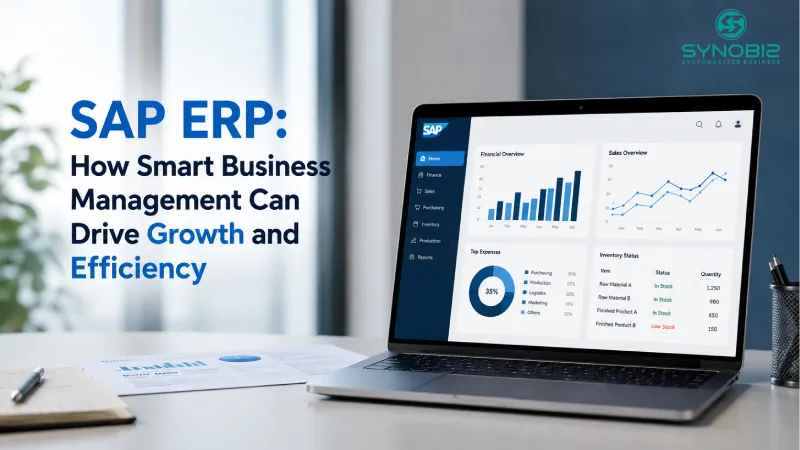
A connected ERP platform can provide visibility into financial performance, sales activity, inventory, purchasing, supply chain operations, and other business functions. SAP identifies deeper insights, accelerated reporting, and improved agility among the potential benefits of modern ERP.
This can help management spend less time collecting information and more time evaluating what the information means.
3. Stronger Financial Control
Nearly all business decisions revolve around finance.An ERP platform can connect accounting with transactions from sales, purchasing, inventory, and other departments.
This gives finance teams a more complete view of business activity and helps management understand how operational decisions affect financial results.
For smaller organizations, SAP Business One provides integrated financial management alongside purchasing, sales, inventory, and reporting capabilities.
4. Improved Inventory and Supply Chain Management
Inventory problems can affect both customer satisfaction and working capital. Too little inventory can delay deliveries, while unnecessary stock can tie up resources.
An integrated SAP System can connect purchasing, inventory, sales, and supply-chain processes so businesses have better visibility into material and product movements.
The exact capabilities depend on the SAP solution selected and the organization's implementation scope.
ERP ROI: What Should Businesses Actually Measure?
Searching for ERP ROI should not mean looking only at direct financial savings.
Businesses can evaluate ERP value through several measurable areas:
- Reduction in manual data entry
- Faster reporting cycles
- Better inventory visibility
- Improved order processing
- Fewer duplicate or inconsistent records
- Better workflow control
- Faster access to management information
- Reduced reliance on disconnected spreadsheets
The actual return varies significantly from one organization to another. It depends on implementation quality, user adoption, business processes, integration, scope, and how effectively the organization uses the system.
A well-defined business case should therefore establish measurable objectives before implementation.
Understanding SAP Software Price and SAP Cost in India
Businesses frequently search for SAP Software Price and SAP Cost in India while researching ERP solutions. However, there is no single amount that accurately represents every SAP project.
The overall commercial scope can be influenced by:
- SAP solution selected
- Number and type of users
- Cloud or on-premises deployment
- Functional requirements
- Implementation services
- Data migration
- Integrations and extensions
- Training and support
- Customization requirements
For example, SAP Business One is positioned by SAP as an ERP solution for small businesses, while other SAP ERP offerings target broader enterprise requirements.
For this reason, businesses should define their operational requirements before comparing SAP Business One Pricing or other SAP commercial options.
What About an SAP Trial?
An SAP Trial can be useful for understanding the software environment, exploring functionality, and becoming familiar with the platform. However, a trial experience does not replace a proper business requirements assessment.
Before moving toward implementation, businesses should identify:
- Which departments need ERP access
- Which processes need automation
- What data needs to be migrated
- Which integrations are required
- What reports management needs
- What users and roles are involved
- Which business processes need customization
This produces a much clearer foundation for ERP planning.
Choosing the Right SAP Partner
ERP implementation is not merely about picking the right software. It involves other critical aspects like implementation itself, process mapping, configuration, data conversion, integration, training, testing, and support.
As SAP mentions on its website, SAP Business One is delivered by the company’s partners.
So partner selection becomes another crucial point in the purchasing decision process.
Our company Synobiz Systems assists companies to identify their ERP needs, assess suitable SAP products, implement, integrate systems, and support them. We always put the business process aspect before the technical one.
Why Choose Us
We at Synobiz Systems provide ERP solutions for clients whose objective is to streamline their operations through increased visibility, better controls, and better business decisions using SAP as well as other ERPs. In order to advise our clients properly on what kind of system will work best for them, we first need to analyze the present working environment of our client which includes departments, processes, reports, integration requirements, users, and future expansion strategies. The scope of our services includes ERP consulting, implementation, customization, integration, upgrade, migration, training, and support. We do not believe in installing ERP into an organization. We strive for the integration of the ERP into the daily processes of the business.
Conclusion
SAP ERP has the ability to provide an integrated platform that will make it easier for businesses to manage their finances, purchasing, selling, inventory, logistics, manufacturing, and many other key operations. The benefit of using SAP ERP lies in integration of the processes and making the business information easily accessible to all departments. In analyzing SAP Software Price, SAP Cost in India, or SAP Business One Pricing, one has to take into account not only the price but also the scope of the implementation, number of users, deployment, integration, data migration, training, and support. Likewise, ERP ROI has to be evaluated based on key objectives.
Looking to choose the right SAP ERP solution for your business? Contact Synobiz Systems at +91 97247 99092 or email info@synobiz.com for SAP consultation, implementation, and support.
Frequently Asked Questions
SAP ERP refers to enterprise resource planning solutions from SAP that integrate crucial business functions within a connected technology environment, enhancing visibility and efficiency across various departments.
SAP ERP improves business efficiency by integrating core business processes, offering better management visibility, and enhancing financial control, allowing teams to work with a single source of truth.
When evaluating SAP software price in India, businesses should consider factors such as the selected SAP solution, the number of users, deployment type, functional requirements, and the level of customization needed.
The key benefits of using SAP ERP include streamlined operations, improved collaboration across departments, enhanced visibility into business performance, and better decision-making based on integrated data.
Synobiz Systems assists with SAP ERP implementation by understanding clients' specific needs, assessing suitable SAP products, managing the implementation process, providing training, and ensuring seamless integration into daily business operations.